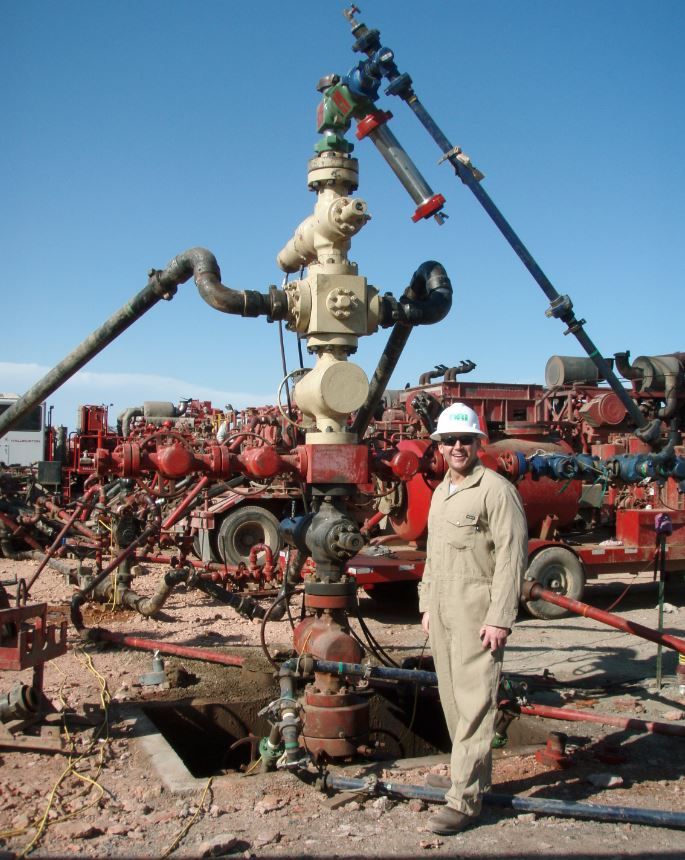
Drilling and well service both move fluid at pressure, but they ask different things of the iron. Drilling iron is part of a rig system that runs for weeks at a time, moving drilling fluid in a steady circuit; well-service iron is rigged up and torn down job by job, and has to be portable, quick to connect, and easy to rearrange on location. The difference shows up in how the line is laid out, how often it is handled, and what a crew checks before the first pump — not in a single pressure number.
Two jobs on the same well
Every well goes through both kinds of work, one after the other. Drilling makes the hole: the rig, the drill string, and the circulating system that carries cuttings back to surface. Well service comes after — and keeps coming back through the life of the well — to complete it, stimulate it, work it over, and keep it producing. Fracturing, acidizing, flowback, and plug-and-abandon work are all well-service jobs, and each one needs a temporary high-pressure line between the pumps and the wellhead.
The iron looks similar from a distance: steel pipe, hammer unions, valves, and swivels, all built to hold pressure. Up close, though, the two jobs put the iron through very different days. A buyer who understands which job the iron is for can order the right pieces, in the right lengths, with the right test records — and a buyer who treats all flow iron as the same risks ordering a line that fights the crew on every job.
What drilling iron has to do
On a drilling rig, the iron is part of a system that stays in place. The circulating system moves drilling fluid down the drill string and back up the annulus, hour after hour, for the whole time the rig is on the hole. The lines that carry that fluid are rigged up when the section starts and stay made up until the section is done. They are not carried from pad to pad, they are not broken down and rebuilt every day, and the crew that watches them is the same crew that watches the rig.
That steady duty shapes what matters. The iron has to hold up under continuous use, and it has to be watched as part of the rig: a leak on a drilling line is found by the crew that walks the rig floor every tour. Choke and kill lines, which are part of the well-control system on a drilling rig, are another example of drilling iron built for a fixed, monitored role — they are in place for the whole job, and they are there for a moment the crew hopes never comes.
Because drilling iron stays put, its layout follows the rig. The runs are planned around the rig's own equipment — the pumps, the standpipe, the mud system — and once the layout is set, it changes only when the hole section changes. Weight and handling still matter, but not the way they do on a job that moves every few days.
What well-service iron has to do
Well-service iron lives a different life. A treating crew arrives with trucks, rigs up a line from the pumps to the wellhead, pumps the stage, tears the line down, and moves to the next well — sometimes the same day. The line is temporary by design, and everything about it has to suit that rhythm: light enough to carry by hand, quick to connect, and easy to rearrange when the next pad is laid out differently.
That is why well-service iron is built around the hammer union. A hammer union makes up with a hammer and a wrench, no torque equipment and no flange bolts, so a crew can build a whole treating line by hand and break it down just as fast. Pup joints in 4, 6, and 10 ft close the measured gaps between the long runs; plug valves isolate sections of the line so one part can be worked on while the rest stays shut in; swivel joints take the bends where the line turns from the pumps toward the wellhead.
Two-inch FIG 1502 iron rated to 10,000 PSI is the size most treating spreads are built around, because it fits the work: strong enough for the treating pressures crews pump at, light enough for a crew to rig up by hand, and widely stocked in the lengths and fittings a line needs. The pieces are the same ones a buyer orders for a frac spread, a flowback job, or a workover — the difference is the layout, not the iron.
Where the two kinds of iron differ
- Duty cycle: drilling iron runs continuously for weeks as part of the rig; well-service iron works in short, hard jobs with a rig-up and a tear-down on each one.
- Rig-up rhythm: drilling lines are installed once per hole section and stay made up; a treating line is rebuilt for every job, sometimes more than once a day.
- Connections: drilling iron stays connected, so a made-up joint can stay made up; well-service iron is made and broken constantly, which is why hammer unions — fast to make up by hand — are the standard.
- Layout: drilling lines follow the rig's fixed equipment; treating lines are laid across the pad from the pumps to the wellhead, and the layout changes with every location.
- Handling: well-service iron is carried, stacked, and trucked between locations, so the weight and length of each piece matter on every load; drilling iron is handled far less often.
- Inspection rhythm: because well-service iron is handled and reconnected so often, it is inspected and pressure tested between jobs — every make-up is another chance to check a sealing surface, a union thread, and a valve that has to hold.
Where Sterling can help
Sterling Wellhead stocks new 2-inch FIG 1502, 10,000 PSI flow iron in Jourdanton, Texas 78026, built for well-service work: the T000856 plug valve, 4 ft, 6 ft, and 10 ft pup joints (T000864, T000866, T000855), and Style 10 and Style 50 swivel joints (T000620, T000693). Whether the job is a frac stage, a flowback, or a workover, send the line list with quantities and drawing numbers, the delivery location, and the required-on-site date, and ask for the pressure test documentation with your RFQ — our team will confirm the configuration by drawing number. Sterling is RFQ-only: contact sales@sterlingwellhead.com or +1 (512) 373-0384.
Frequently asked questions
Is drilling iron and well-service iron interchangeable?+
Not by assumption. The same size and union figure does not make a piece right for both jobs — what matters is the pressure rating, the figure, and the condition of the piece, including its test records and service history. A piece can serve in either job only if it matches the job on all three. When in doubt, ask the supplier what the piece was used for and what its last test record shows, and order by drawing number.
Why does well-service iron use hammer unions?+
Because the line is built and broken down constantly. A hammer union makes up with a hammer and a wrench — no torque equipment, no flange bolts — so a crew can rig up a whole treating line by hand and tear it down just as fast. On a drilling rig, where lines stay made up for weeks, that speed matters less; on a treating spread, where the line moves every job, it is the whole point.
What should a buyer ask when ordering iron for well service?+
Send the line list with quantities and drawing numbers, the size and union figure, the delivery location, and the required-on-site date, and ask for the pressure test documentation with the quote. Well-service iron is handled and reconnected often, so the test record — the piece, the test pressure, the hold time, and the date, tied to the piece by drawing number — is part of what you are buying.