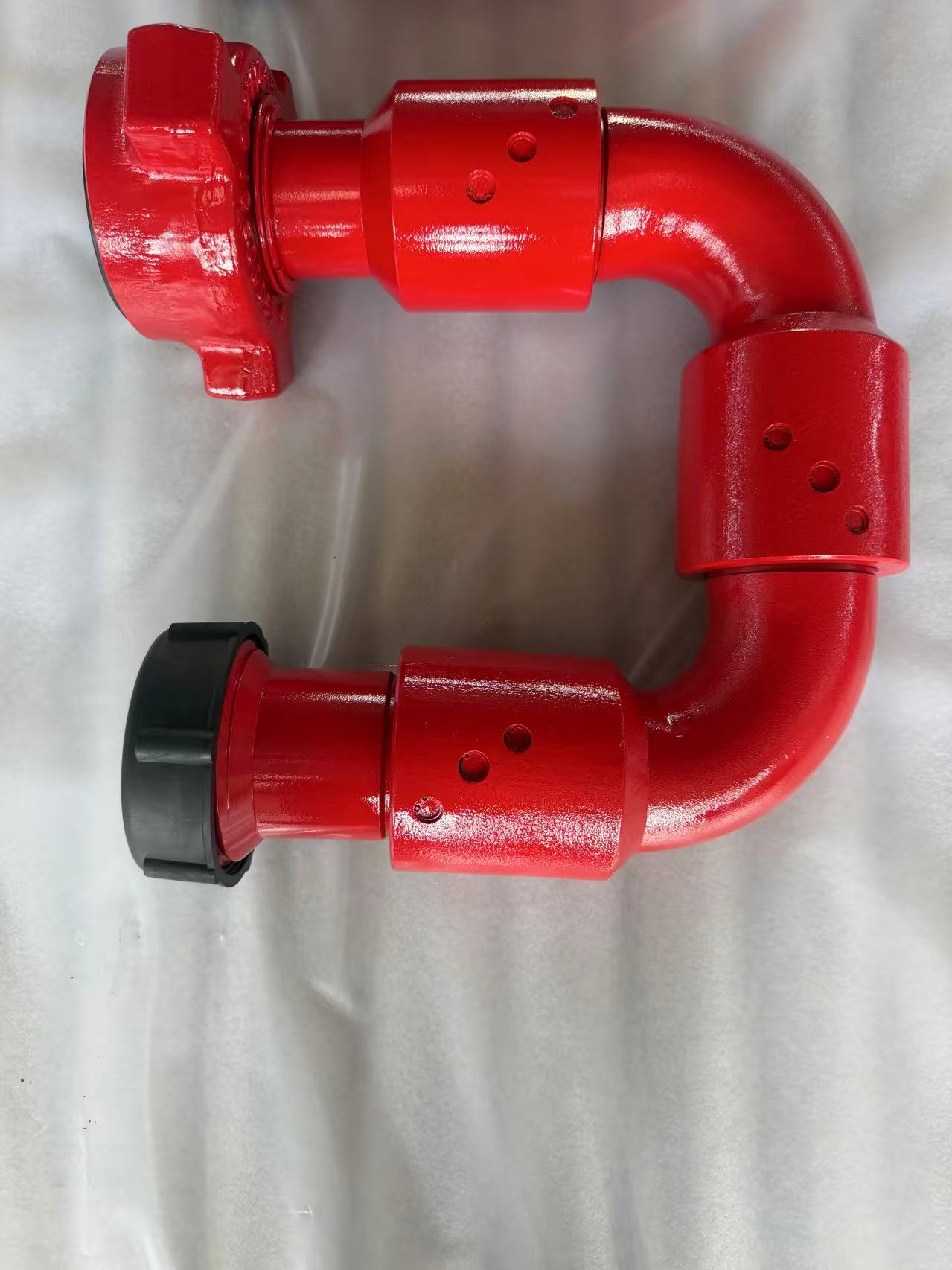
For most treating work, 2-inch FIG 1502 iron rated to 10,000 PSI is the standard choice: it handles the rates frac and well-service crews commonly pump, it is widely stocked, and it is light enough for a crew to rig up by hand. Larger sizes earn their place when a job needs higher flow with less pressure loss, or when the line is long and every fitting adds friction — but they cost more, weigh more, and need more room. The right size is the smallest bore that still moves the job's rate comfortably within the pressure rating of every piece in the line.
What line size actually decides
Line size sets how fast fluid moves through the iron at a given pump rate. A smaller bore means higher velocity for the same rate, and higher velocity means more friction loss along the line and through every bend, swivel, and valve — pressure that is spent pushing fluid through the iron instead of doing work at the wellhead. A larger bore slows the fluid down, cuts that loss, and leaves more of the pump's pressure available where it matters.
Velocity matters for another reason: wear. Abrasive fluid moving fast through iron wears sealing surfaces, union faces, and swivel packing faster than the same fluid moving slowly. That is why line size is not just a flow question but a service-life question — the iron that looks cheapest on the truck may cost more in packing, inspection, and early replacement if it runs hard on every job.
The case for 2-inch iron
Two-inch iron is the default on most frac spreads for practical reasons, not habit. FIG 1502 unions in 2-inch are the most widely stocked size, so pup joints, plug valves, and swivels in that size are the easiest to find, the fastest to replace, and the most likely to match the iron already on location. A 2-inch line is also light enough for a crew to handle, lay out, and make up without extra lifting equipment, which keeps rig-up moving.
For the treating rates most spreads pump, 2-inch iron rated to 10,000 PSI covers the job with margin, and it matches the pump discharge, manifold, and wellhead connections crews already run. That commonality is worth as much as any flow calculation: when every piece on the spread is the same nominal size and union figure, there are no adapters to hunt for, no mismatched make-ups, and no last-minute swaps.
When to go bigger — and what it costs you
Larger iron earns its place on jobs where the rate is high, the line is long, or the route has many bends. A bigger bore moves the same rate at lower velocity, which means less pressure lost to friction over a long run and less wear on the iron. On a spread where the treating line runs a long distance from the pumps to the wellhead, that difference can be the margin between a comfortable pump pressure and one that runs near the top of its range.
The trade-offs are real. Larger iron costs more per foot, weighs more, and takes more room on the truck and on location. Every fitting — valves, swivels, pup joints — has to be the larger size too, so the cost and the weight grow across the whole line, not just the straight runs. Bigger iron can also be slower to rig up, because each piece is heavier to carry and to make up. Going bigger is the right call when the flow and the layout demand it; going bigger just in case is weight and money the spread carries for no return.
Sizing the line as a system
- Match the size end to end: pump discharge, manifold, treating line, and wellhead connection should all be the same nominal size and union figure, so the line makes up without adapters and every joint seals the way it was designed to.
- Rate the line by its weakest piece: the safe working pressure of the assembled line is set by the lowest-rated component in it, not by the strongest. Check the rating on every valve, swivel, and pup joint before the job, not just the straight pipe.
- Count the bends: every swivel and elbow adds friction, so a line with many turns loses more pressure than a straight run of the same length. Choose the route first, then check whether the size still works with the bends in it.
- Close the gaps with pup joints: stock pup joints in 4 ft, 6 ft, and 10 ft let the crew land the line exactly where the layout needs it, instead of forcing a run together or leaving a joint under strain.
- Leave room to handle it: bigger iron needs more truck space, more laydown room, and more crew to move safely. If the location is tight, the size that fits the route is the size that works.
- Ask for the test records: whatever size you choose, confirm the pressure test documentation for the iron before it ships, so the line that arrives is the line the job was planned around.
Where Sterling can help
Sterling Wellhead stocks new 2-inch FIG 1502, 10,000 PSI flow iron in Jourdanton, Texas 78026, including the T000856 plug valve, 4 ft, 6 ft, and 10 ft pup joints (T000864, T000866, T000855), and Style 10 and Style 50 swivel joints (T000620, T000693). Send the pump rate, the line length and layout, the wellhead connection size, and the required-on-site date, and ask for the pressure test documentation with your RFQ — our team will confirm the configuration by drawing number. Sterling is RFQ-only: contact sales@sterlingwellhead.com or +1 (512) 373-0384.
Frequently asked questions
Is 2-inch iron enough for most treating work?+
For most frac and well-service treating work, yes — 2-inch FIG 1502 iron rated to 10,000 PSI is the size most spreads are built around, and it matches the pump discharge, manifold, and wellhead connections crews commonly run. Larger iron is worth considering when the rate is high, the line is long, or the route has many bends and the pressure loss starts to matter. The deciding factors are the job's rate, the length and layout of the line, and the rating of every piece in it.
Can I mix line sizes in one treating line?+
It can be done with the right adapters, but a line built to one size is simpler and safer: every make-up matches, every rating is the same, and no joint depends on an adapter that might not be on the truck. If a size change is unavoidable — for example, where the line meets a wellhead connection in a different size — plan the transition at a fixed point, confirm the rating on both sides of it, and make sure the adapter and its test record are on the line list.
What should I send when asking about line size?+
Send the pump rate and the treating pressure the job calls for, the approximate length and layout of the line, the size and figure of the wellhead connection, and the required-on-site date. With that, a supplier can confirm whether 2-inch iron covers the job or a larger size is worth quoting, and check stock and test records against your dates.